
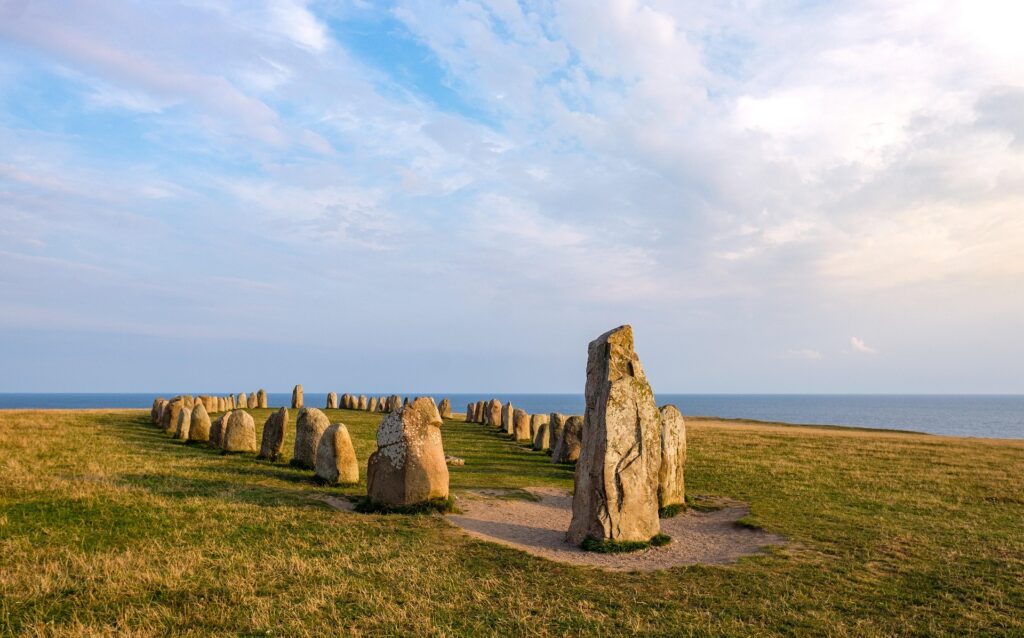
No, the Eco-Pagan Calendar is not in the set of stones in the photo to the right. Though it’s quite possible that those stones were originally used as a calendar. But the Eco-Pagan Calendar, also known as the Earth Epic Calendar, is an effort to encompass the entire history of the Earth in one non-Gregorian calendar. It is an effort to look at time and history from Earth’s point of view.
Catching up with Earth history
Our understanding of Earth’s history and humanity’s place in has changed radically in the last 400 years. So why is the world using a calendar with only minor changes since Julius Caesar’s reforms in 45 BCE?
Four hundred years ago, scholarly beliefs about the age of the Earth tended to be in the thousands of years. But with the advances of geology in the 19th century, estimates began to climb into the tens of millions. With the invention of radiometric dating in the early 20th century, estimates climbed into the billions. We now know that if the history of the Earth were a 24-hour clock, humans would have arrived at 23:58 and 43 seconds. The Industrial Revolution would have started at 23:59 and 59 seconds.
But thanks to developments in that last “second,” we are making decisions that could affect our planet for thousands of years, and affect life that has evolved over millions of years. Might our short-sightedness be, in part, due to a calendar that sets Year 1 some two thousand years ago?
How to say ‘billions’ without saying ‘billions’
Humans struggle with concept of millions and billions. For example, one million seconds is about 11 1/2 days, while one billion seconds is 32 years. We simply can’t visualize quantities ending in “illion.” However, we can visualize one hundred by visualizing a ten-by-ten grid.
The Eco-Pagan calendar starts with three units of time larger than each other by factors of one hundred.
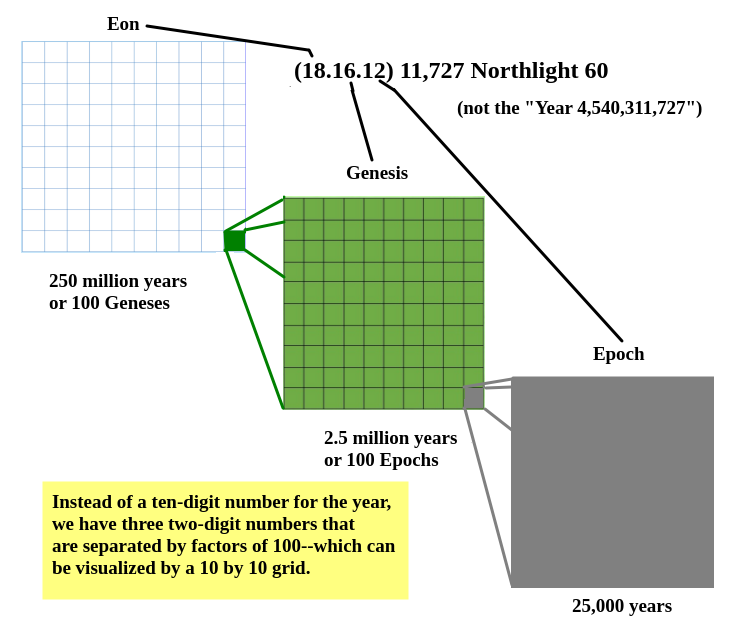
The largest of these is the Eon, which lasts 250 million years. This span of time is roughly equivalent to a Galactic Year, the time it takes for the Solar System to orbit the Milky Way. It’s also roughly the length of time between when the dinosaurs evolved and now. We are currently in Eon 18, which began roughly 40 million years ago.
The Genesis is 1/100ths of the length of an Eon, or 2.5 million years. That is the length of time roughly equal to the beginning of the Quaternary Period and the present. The Quaternary period is when our current Ice Age began–we are still in an Ice Age, but in a warmer “interglacial period.” It is also when the the genus Homo is estimated to have evolved-. We are currently in Genesis 16, which began 311,727 years ago, or the approximate time Homo Sapiens evolved.
The smallest of these “Epic Time Scales” is the Epoch, which equals 1/100th of a Genesis, or 25,000 years. This is the rough equivalent of an axial precession, the period of time when the Earth appears to go through all twelve zodiac ages. Remember the Age of Aquarius? Multiply that by twelve and you have the axial precession. We are currently in Epoch 12, which began in 9701 BCE (11,700 years before Y2k), which is the start of the Holocene. This date was set by the International Stratigraphic Association in 2008 based on the study of specific Greenland ice cores. The current Epoch also eoncompasses
Looking at the Epic Time Scales, we can see, for example, that life on Earth apparently began during Eon 2, but first multicellular life didn’t evolve until Eon 14, and first land animals didn’t exist until Eon 16. See how much clearer Earth history becomes from this standpoint?
Approaching the year 11,727 EE
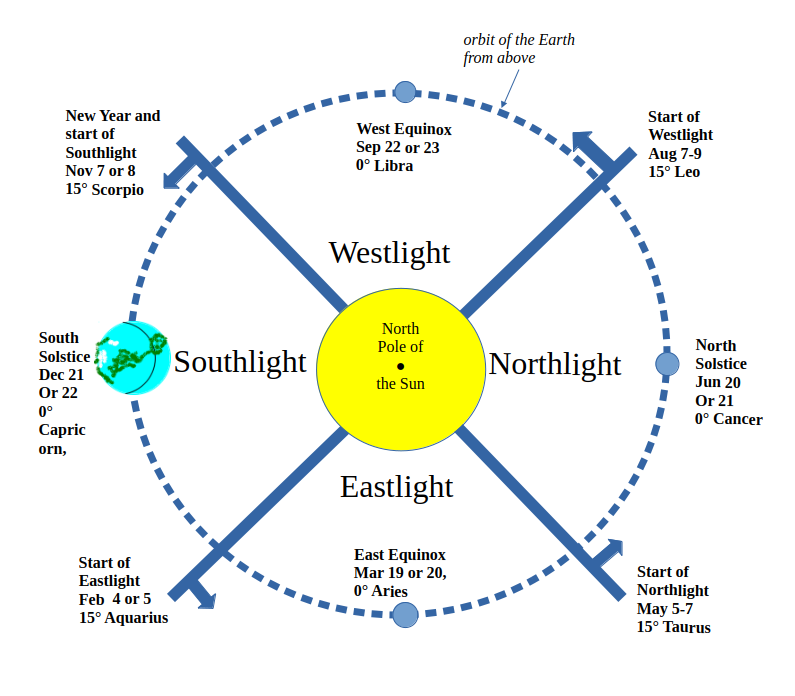
The year is divided into four quarters, which are divided at the cross quarters. This means that the halfway points of each quarter are on the solstices and equinoxes.
While the quarters appear to be equally spaced, each quarter is a slightly different length, ranging from 88-94 days. The elliptical nature of Earth’s orbit causes the Earth to take different amounts of time between seemingly equal points on the circle.
It’s not exactly true that the Irish and Scottish Pagan holidays are based on the cross-quarters. They happen to be near the cross-quarters, but there is no evidence that the ancient Celts calculated the cross-quarters. The Coligny Calendar is the most complete representation of ancient Celtic astrology uncovered thus far, and no cross-quarters are represented in that calendar.
But one sweet advantage of having the quarters set up like they are is that for either hemisphere, one quarter has all of the longest days and shortest nights of the year, one quarter has all the shortest days and longest nights of the year, and two quarters where the lengths of days and nights are most equal.
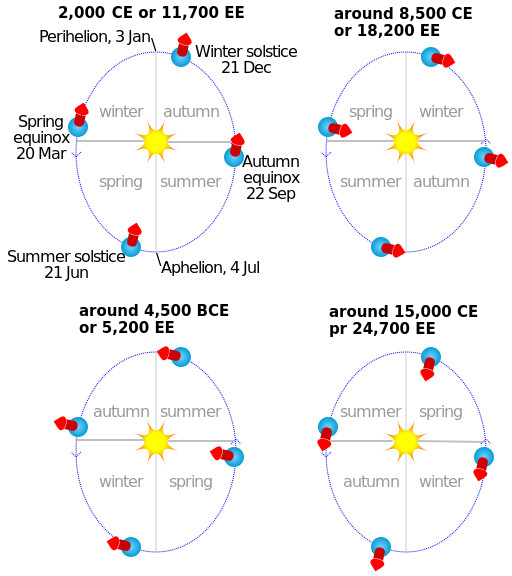
The lengths of these quarters also change over time. This is because of the elliptical nature of the Earth’s rotation. Over a period of an axial precession—roughly 265000 years—the lengths of these quarters will rotate. In 1689 CE, Westlight became longer than Eastlight. Sometime after 4000 CE, Westlight will become the longest quarter, exceeding that of Northlight.
The Eco-Pagan calendar is also more accurate than the Gregorian Calendar. The Gregorian calendar wasn’t even the most accurate calendar in the world at the time of its introduction in 1582.
That honor at the time belonged to the Jalali Calendar introduced in what is now Iran back in 1079 CE. This calendar, and the modern Solar Hijri Calendar that succeeded it in 1925, base their new year on the midnight closest to the moment of the March Equinox. Then the length of the year is based simply on the length of time between that new year and the next new year. Usually, that’s 365 days, but sometimes it’s 366. Typically the pattern is an interval of four years between leap years, but once every 33 years or so, an interval of five years exists. By adding leap years only when needed, the start of the year stays true to the New Year.
The Eco-Pagan calendar’s new year, however, starts at the crossquarter between the fall equinox and summer solstice. It is located at 15° Scorpio, which falls around November 7 or 8. So the new year is closer than you think!
The Eco-Pagan Calendar as a teaching instrument
With the sophistication of the Eco-Pagan Calendar/Earth Epic Calendar, it’s possible to learn many things about our Earth, such as:
- The distinction between twelve lunar months and twelve solar months.
- How Earth’s elliptical orbit impacts the lengths of seasons and how the lengths of those seasons can change over tens of thousands of year.
- How axial precession has caused Western and Vedic astrology to plot the same astrological signs at slightly different times of the year.
- When the Holocene Epoch started, help understand the significance of it, and give people a clearer idea of human history over the last 12,000 years.
- How long Homo Sapiens has existed compared to the entire genus Homo.
- The percentage of Earth’s history that life has existed, and what percentage of that time multicellular life has existed.
Buy your own copy of the Eco-Pagan Calendar/Earth Epic Calendar
You can buy either a paper or .pdf copy of the Eco-Pagan Calendar/Earth Epic Calendar at the Etsy Earth Epic Resources store. The Eco-Pagan New Year is coming November 7.