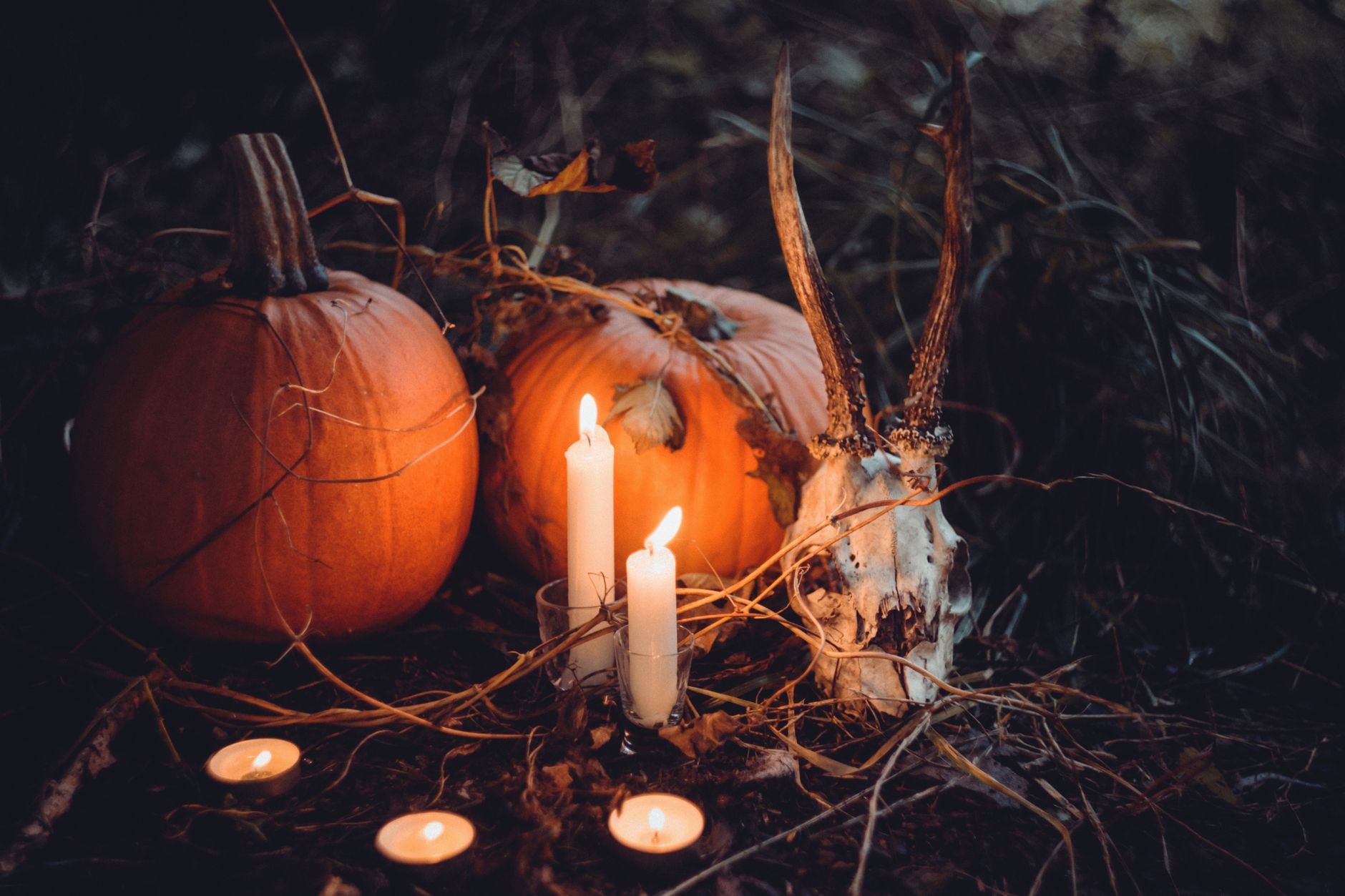
This past Sunday I had a wonderful Samhain/New Year ceremony with a group of friends. People may wonder why I celebrated it the other as opposed to October 31 or November 1. There are many reasons for this that extend beyond Samhain itself.I also have the desire to create new traditions specific to my area and my practice.
What Samhain is and isn’t
A widespread belief on the Internet says that Samhain should be celebrated on October 31 or November 1. There is another widespread Internet belief that insists “you’re doing it wrong” if you celebrate Samhain on any day other than the day of the November cross-quarter (which is usually November 7 or 8). Those who insist on this also say that the ancient Celts astronomically calculated the cross-quarters—the halfway points between the solstices and the equinoxes. But I haven’t seen any evidence that ancient Celtic peoples calculated these cross-quarters. The scholars I trust say that there is no evidence of this.
What is arguably more relevant is that the word “Samhain” in the Irish and Scottish Gaelic name for November. And author Lora O’Brien, who is arguably one of the strictest defenders of Irish tradition has said that Samhain can be celebrated October 31. Or it could be celebrated at the astronomical cross-quarter which is usually a week later. Or someone could even dedicate the entire month of November–or the nearest lunar month–to Samhain.
So this year, I chose to celebrate it on the cross-quarter. Not because I felt like I had to, but because I wanted to.
But what are we honoring?
When I first became Pagan in the 1990s, we were taught that being a Pagan meant celebrating the Wheel of the Year. Why? Because a lot of us were told that celebrating these holidays made us Pagan. Really, it was Wicca we were all practicing,but this was a time when the Internet was in its infancy. In the U.S., the Minnesota-based Llewellyn company was the chief publisher of books about Paganism, and many Pagans had decidedly mixed feelings about the publisher which persist to this day.
That was one of the reasons I left the Pagan community before the decade ended. The other reason was that these rituals were focused on “raising energy.” Some people were into a Wiccan concept of a “cone of power,” but with no real thought about what to do with that power.
Still, honoring ancestral traditions and drawing lessons from the past can be a big part of that power. I have celebrated Samhain because of my Scottish and Irish heritage. I have friends in Scotland and Ireland, and millions of Americans including myself share that heritage.
There will always be value in honoring those traditions, as long as these traditions are honored on their own terms. I have written quite a bit about the level of misinformation out there about ancient traditions, particularly those of Celtic origin. Such misinformation can inflict real harm on cultures trying to preserve themselves.
Creating new traditions
Honoring ancient ethnic traditions is valuable, but it’s not something every Pagan has to do. I think our times also call on those of us who feel motivated to create new Pagan traditions separate from Celtic, Norse, Greek, or other ancient traditions. Our world is very different from what it was two, three, and four thousand years ago. With the peril that our ecosystem is in, the times call for us to think outside the box.
When my nerd project that eventually became the Eco-Pagan Calendar took on a life of its own, I began to see value in creating spaces in the calendar for new traditions. New traditions can be good for any day of the year.
People celebrate solstices and equinoxes in different ways all over the world. As such, there is little harm in inventing one’s own traditions for those specific days. But the same isn’t true for Samhain, Imbolc, Bealtaine, or Lughnasadh. (For an egregious example of the harm inventing new traditions under the name of an existing tradition can do, look no further than this. And don’t even get me started on the Celtic Tree Calendar.) However, there is nothing saying that the Celts have or should have a monopoly on cross-quarter celebrations. Indeed, the solar term calendar, which started in China and then spread to Korea, Japan, and Vietnam, bases its seasons on the cross-quarters.
My own traditions
For my own practice, I began to see the value of the astronomical cross-quarters. These are calculated by astrologers as being located at 15° Scorpio, 15° Aquarius, 15° Taurus, and 15° Leo. One thing I was surprised to discover was cross-quarters neatly establish quarters that contain either all the longest days of the year, all the shortest days of the year, or quarters where the days and nights are most equal. As an Earth-oriented Pagan, I realized there is power in looking at the year in this way.
As such, Saturday, November 7, the day of the most recent cross-quarter, was the first day of the new year on the Eco-Pagan Calendar. The year 11,727 marks the number of years since the widely recognized start of the Holocene set by the International Commission on Stratigraphy.
On my calendar, I call the beginning of these quarters the Advents. Right now we are at the South Advent, the beginning of the quarter where the most direct sunlight hits the Earth at its southernmost points. This brings the Northern Hemisphere its shortest days and longest nights. I see the South Advent and other Advents as a open space for people to start their own traditions. And if someone wanted to invent “12 fertility deities” they could do so without trashing existing traditions.
This is what my South Advent looks like so far: Where I live, I close the window, there’s fewer people on the street. It’s a wonderful time to turn inward, which I see as an ideal time for germination of new ideas. It’s a great time to start a new year. There’s no hurry to plant new things. We can take the time we need to create the magic we create.
Finding new traditions
In an earth-oriented spiritual path, creating a new tradition offers opportunities to tune in with the environment around us, wherever we live. This is a time to think about the season, the environment, the Earth as it manifests in our own corners of the world. We can see what is there to observe, to mark, to celebrate.
With my own Pagan group, I did a guided meditation on the season in an effort to encourage creating thinking about this. I encouraged people to think about a nature area near where they lived. I encouraged them to think about what the land looks like, sounds like, smells like, etc. I asked them to imagine the flora and fauna of the area. I asked them to think about what they thought the land was trying to tell them. I asked them to consider what the Earth beneath them wanted them to honor.
This won’t usually create new traditions right away, but it’s an exercise that can stimulate thought of what such traditions might look like.
I’ve often asked myself in recent months if it is really my place to create a calendar and new Pagan holidays. My answer is that yes, it is, and it is your place to do whatever works best for you. There is valid reason to keep alive the dynamic ancient traditions on their own terms if that’s what you want to do. And there is a place to build your own tradition, either on the broad plot of land that I offer in the Eco-Pagan Calendar, or elsewhere completely on your own terms. Paganism and magic give us that freedom.